Property Investment Guide for Beginners: ROI, Location, and Exit Strategy
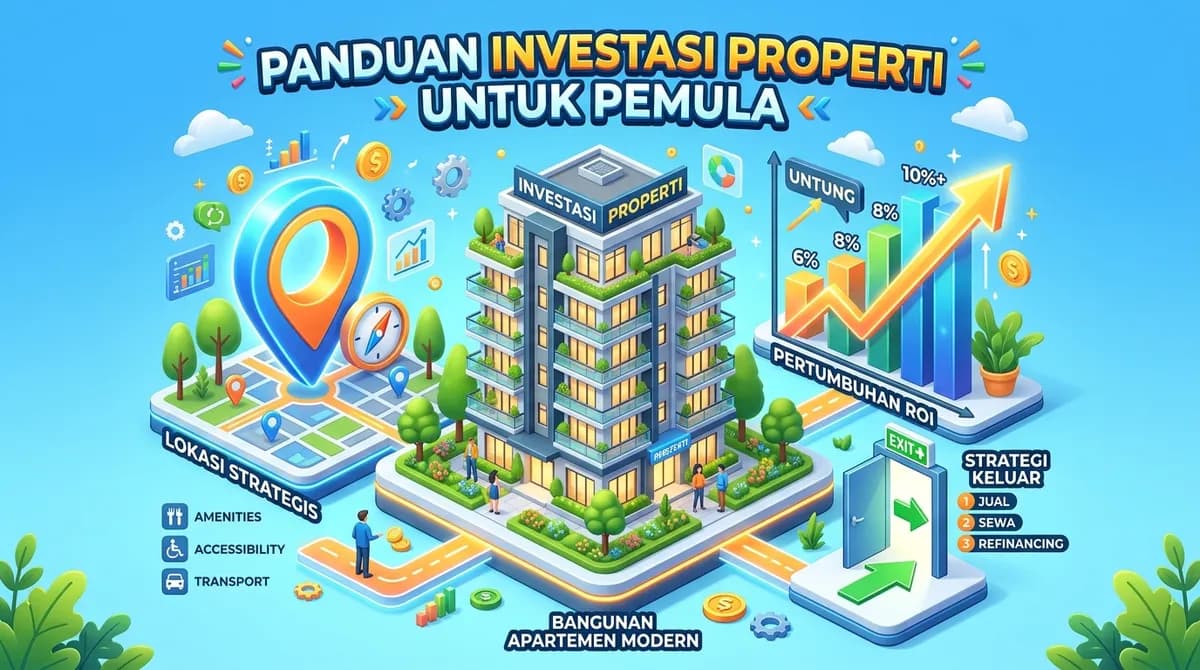
New to property investing in Indonesia? This complete 2026 guide covers how to calculate ROI accurately, choose the right location, and design a smart exit strategy from day one — with real market data and practical simulations.
Property Investment Guide for Beginners: ROI, Location, and Exit Strategy
Property investment has long been the cornerstone of wealth-building in Indonesia. Land prices that climb year after year, a housing demand that never contracts, and the appeal of steady passive rental income have made property one of the most consistently rewarding asset classes across decades. Yet for beginners, the world of property investing can feel like a maze — dense with legal terminology, apparently requiring enormous capital, and full of risks that aren't visible from the surface.
The good news: property investment in 2026 remains one of Indonesia's most sought-after investment instruments, offering both long-term capital appreciation and passive income potential through rentals. And contrary to popular belief, getting started doesn't require billions of rupiah.
This is a complete beginner's guide — covering how to calculate ROI accurately, how to choose the right location, and how to design a smart exit strategy from day one.
Why Property Still Makes Sense in 2026

Before diving into mechanics, it helps to understand why property remains a fundamentally sound investment even when flashier alternatives compete for attention.
Bank Indonesia recorded that the residential property price index for primary properties rose an average of 4–6% annually in 2026, driven by continued middle-class growth and ongoing urbanization. This may not match the headline returns of a bull-run stock market, but its consistency is precisely the point — property cannot lose 30% of its value overnight the way digital assets can.
Beyond appreciation, property offers something no purely financial asset can: a physical, tangible store of wealth that generates income, protects against inflation, and can be passed down as inheritance. These characteristics make it a foundational asset class for any serious long-term wealth strategy.
Types of Property Suitable for Beginners
Not every property type is appropriate as a first investment. Here are the most relevant options for beginners in 2026:
1. Landed Houses in Developing Areas
Landed houses are the most popular property investment in Indonesia, and for good reason: they carry stable demand, can serve as both a personal residence and an investment asset, and typically come with SHM (full ownership certificate) — the strongest legal protection available under Indonesian property law. Houses in developing corridors tend to show strong price appreciation as surrounding infrastructure matures.
2. Land Plots on the Urban Periphery
Raw land is often considered the safest long-term property investment. Its value increases as surrounding areas develop, it carries no building maintenance costs, no tenant management burden, and no depreciation of structures. Land plots near planned infrastructure projects — toll roads, MRT extensions, industrial zones — consistently outperform the general market. For beginners with limited capital, a small land plot in a developing sub-district can be an excellent entry point.
3. Mortgaged Property (KPR Leverage Strategy)
For beginners who don't have sufficient capital to buy outright, purchasing property through a KPR (home mortgage) is a legitimate and widely used leverage strategy. The bank finances the bulk of the purchase, and rental income partially or fully offsets the monthly installment. When executed correctly — with rental yield exceeding monthly carrying costs — this strategy allows you to build a property asset using primarily the bank's money.
4. REITs and Property Crowdfunding (Starting from IDR 100,000)
For those not yet ready to commit to a physical property, Indonesia's 2026 market offers digital entry points. DIRE (Dana Investasi Real Estate — the Indonesian equivalent of REITs) can be accessed with as little as IDR 500,000, while property crowdfunding platforms licensed by OJK allow participation from IDR 100,000. These instruments are ideal for learning the market's dynamics before committing to a physical asset.
How to Calculate Property ROI Accurately
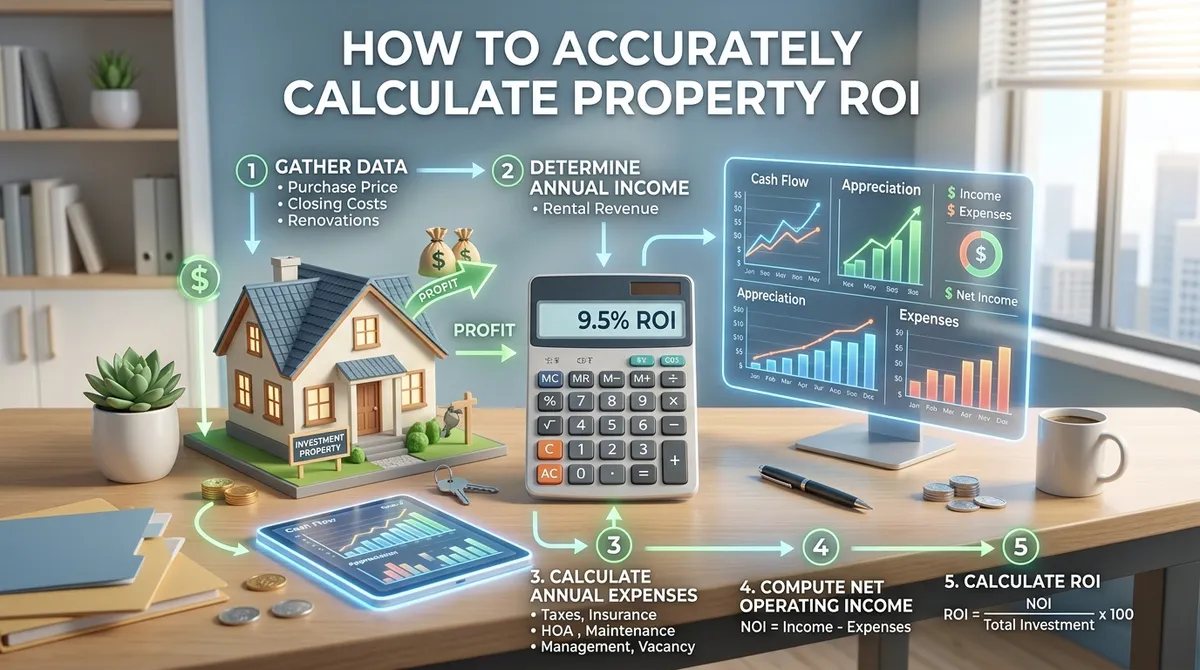
This is the step most beginners skip — and the most common source of disappointment later. Many first-time investors buy based on gut feeling or an agent's recommendation without ever running the actual numbers.
The core formula:
ROI = (Net Annual Profit ÷ Total Capital Invested) × 100%
Property ROI comes from two sources: rental yield (recurring income) and capital gain (price appreciation). Experienced investors account for both.
Practical ROI Simulation
Suppose you purchase a landed house with the following figures:
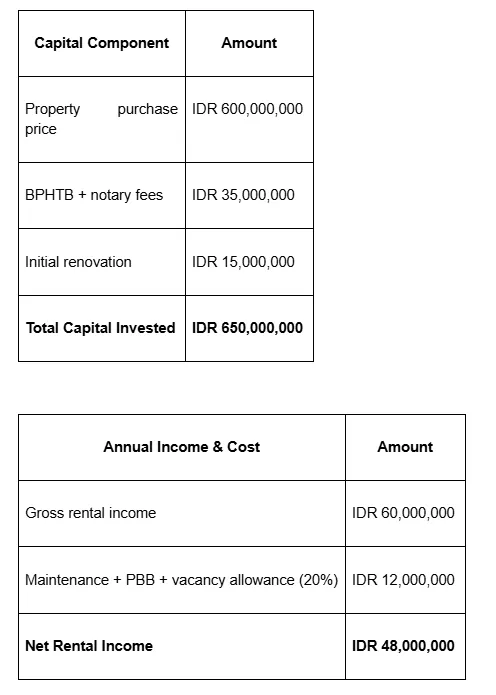
Net Rental Yield = IDR 48M ÷ IDR 650M × 100% = 7.38% per year
The ideal rental yield for property investment is 5%–10% per year. A 7.38% net yield is healthy. Add an estimated capital gain of 4%–6% annually, and the total return on this investment reaches 11%–13% per year — competitive against most financial instruments.
The Most Common ROI Mistake Beginners Make
Many beginner investors calculate ROI using only the purchase price as their total capital — which artificially inflates the apparent return. Total capital must include every upfront cost: purchase taxes, notary fees, registration fees, renovation costs, and any furniture or fitting expenses. Excluding these creates an ROI calculation that looks good on paper but doesn't reflect reality.
Costs that regularly disappear from beginner calculations: vacancy periods (months without rental income), unplanned repair expenses, annual rental income tax of 10%, and the real impact of inflation on net yield over time. If the property's net yield is below Indonesia's annual inflation rate — recorded at 3.08% in May 2026 — the real return is actually negative even if the nominal yield looks positive.
Pemberitahuan Redaksi (Editorial Disclosure)
Artikel di PropertyID disusun melalui proses riset dan penulisan berbantuan teknologi, kemudian ditinjau dan divalidasi oleh tim redaksi sebelum dipublikasikan untuk memastikan keakuratan informasi, khususnya terkait data regulasi, simulasi finansial, dan ketentuan perbankan yang berlaku.
Tim Redaksi
Tim redaksi PropertyID menyajikan berita, analisis, dan panduan properti terpercaya.
Recommended for You
Guide to Buying Bank Foreclosed Houses in Indonesia (lelang.go.id): 30-50% Discounts & Legal Eviction Steps
August 25, 2026

How to Calculate Rental Yield for Houses and Boarding Houses: Beginner Property Passive Income Guide 2026
August 24, 2026

Bali & Lombok Villa Real Estate Investment: Nominee Agreement Dangers vs 100% Legal Options
August 23, 2026