
National Housing Backlog Update and Latest Housing Program
Indonesia's national housing backlog remains a major challenge. Get the latest update on the 3 Million Homes Program, FLPP and KUR Housing schemes, and the BSPS home renovation program in 2026.
National Housing Backlog Update and the Latest People's Housing Program
Indonesia's shortage of adequate housing, commonly referred to as the housing backlog, remains one of the country's major challenges as of mid-2026. Amid these challenges, however, the government continues to accelerate various people's housing programs, with results that are starting to show tangible progress. Here's the latest overview of the national housing backlog situation and the ongoing developments in Indonesia's people's housing programs.
How Large Is Indonesia's Housing Backlog Right Now?
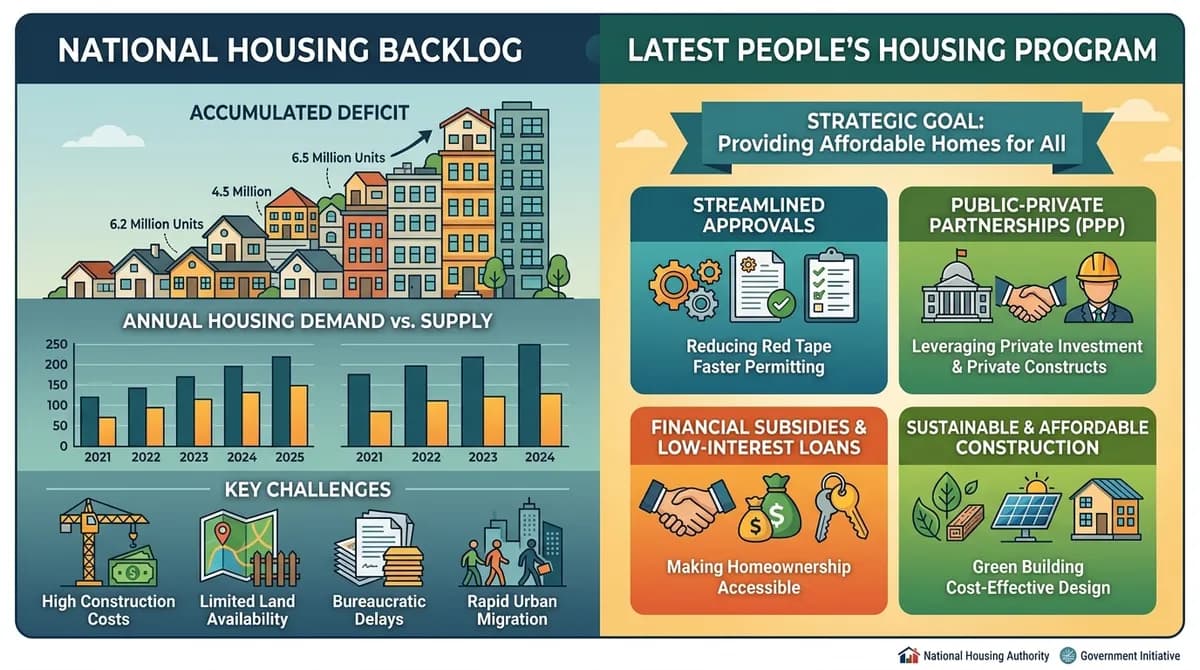
The government's current housing provision program is aimed at addressing the needs of around 9.9 million families who do not yet own a home, while also repairing approximately 26.9 million housing units across Indonesia that are considered unfit for habitation. This figure confirms that the housing backlog issue isn't just about the shortage of homes, but also involves the quality of existing housing that hasn't yet met livability standards.
The 3 Million Homes Program: The Government's Main Strategy
The Construction and Renovation Program for 3 Million Homes has become the backbone of the government's strategy to reduce the national backlog. This program represents one of the tangible commitments made by President Prabowo Subianto to achieve equitable prosperity for all Indonesian people and address socioeconomic disparities.
According to data from the Ministry of Housing and Settlement Areas (PKP), the program's national realization had reached 324,213 units as of mid-June 2026. Of that total, the developer track recorded the largest achievement with 181,291 units out of a target of 635,122 units, while the state track had only reached 55,655 units out of a target of 510,046 units.
The Financing Schemes Being Used
President Prabowo Subianto explained that the Three Million Homes Program is delivered through several schemes, one of which is home purchases through subsidized mortgages (KPR) backed by the Housing Financing Liquidity Facility (FLPP). Beyond FLPP, the program is also supported by the disbursement of People's Business Credit (KUR) for Housing, targeted at low-income segments of society.
As of the end of July 2026, nationwide KUR Housing disbursement had reached Rp22.11 trillion, or roughly 57.81 percent of the Rp38.24 trillion target, with the number of recipients reaching 99,562 debtors. As one of the main distributing banks, 12-1">BRI recorded KUR Housing disbursement of Rp10.6 trillion as of July 2026, or about 88.3 percent of the government's target, achieving 77,592 units — 167 percent of the initial target of 46,230 units.
The Home Renovation Program (BSPS) for Substandard Housing
Beyond building new homes, the government is also focused on repairing existing homes that are unfit for habitation through the Self-Help Housing Stimulant Assistance Program (BSPS), also known as "home renovation." This program is the Ministry of PKP's largest program throughout 2026, with a budget allocation of Rp8.57 trillion — around 68.4 percent of the ministry's total budget ceiling — targeting the construction and quality improvement of 400,000 housing units.
Notably, public interest in this program has been very high, evidenced by submitted renovation proposals reaching 1,898,275 units, far exceeding the available quota. This reflects the significant real-world demand for renovation assistance among households living in substandard housing.
Regulatory Challenges at the Regional Level
While physical program realization is moving fairly quickly, the government still faces challenges in harmonizing policies between central and regional governments. As of early 2026, 230 regencies and cities had yet to implement exemptions on Building Construction Approval (PBG) fees for low-income communities, while another 451 regions had not yet executed exemptions on Land and Building Rights Acquisition Duty (BPHTB), even though the legal framework was already in place.
To address this, Minister of PKP Maruarar Sirait revealed that his ministry is currently drafting a Housing Law aimed at accelerating backlog resolution through stronger data, financing, land access, and cross-ministerial coordination.
Plans to Establish New Cities
As a long-term solution, the government is also developing a strategy to establish 10 new cities in regions with high housing backlog rates, as an effort to distribute residential areas more evenly while also developing new economic centers outside the country's major cities.
What Does This Mean for Those Applying for Subsidized Housing?
For low-income communities planning to apply for subsidized housing programs, these developments carry several important implications:
Financing opportunities are expanding through both the FLPP and KUR Housing schemes, which continue to be scaled up by various banks, including BRI as one of the largest distributors.
The home renovation program has a long waiting list, so anyone planning to apply for BSPS should prepare their documents early and check the application process in their respective region.
Implementation still varies between regions, making it important to check local PBG and BPHTB exemption policies before applying to build a home.
New regulations could simplify the process going forward, as the government continues drafting the Housing Law to strengthen data systems and cross-ministerial coordination.
Conclusion
While the national housing backlog remains a significant challenge, with nearly 10 million new housing units needed and tens of millions of homes requiring renovation, the government has shown tangible commitment through the 3 Million Homes Program, the FLPP and KUR Housing financing schemes, and the BSPS renovation program. Still, harmonizing regulations at the regional level remains unfinished business that needs to be resolved for the acceleration of people's housing provision to run more effectively in the years ahead.
Pemberitahuan Redaksi (Editorial Disclosure)
Artikel di PropertyID disusun melalui proses riset dan penulisan berbantuan teknologi, kemudian ditinjau dan divalidasi oleh tim redaksi sebelum dipublikasikan untuk memastikan keakuratan informasi, khususnya terkait data regulasi, simulasi finansial, dan ketentuan perbankan yang berlaku.
Tim Redaksi
Tim redaksi PropertyID menyajikan berita, analisis, dan panduan properti terpercaya.